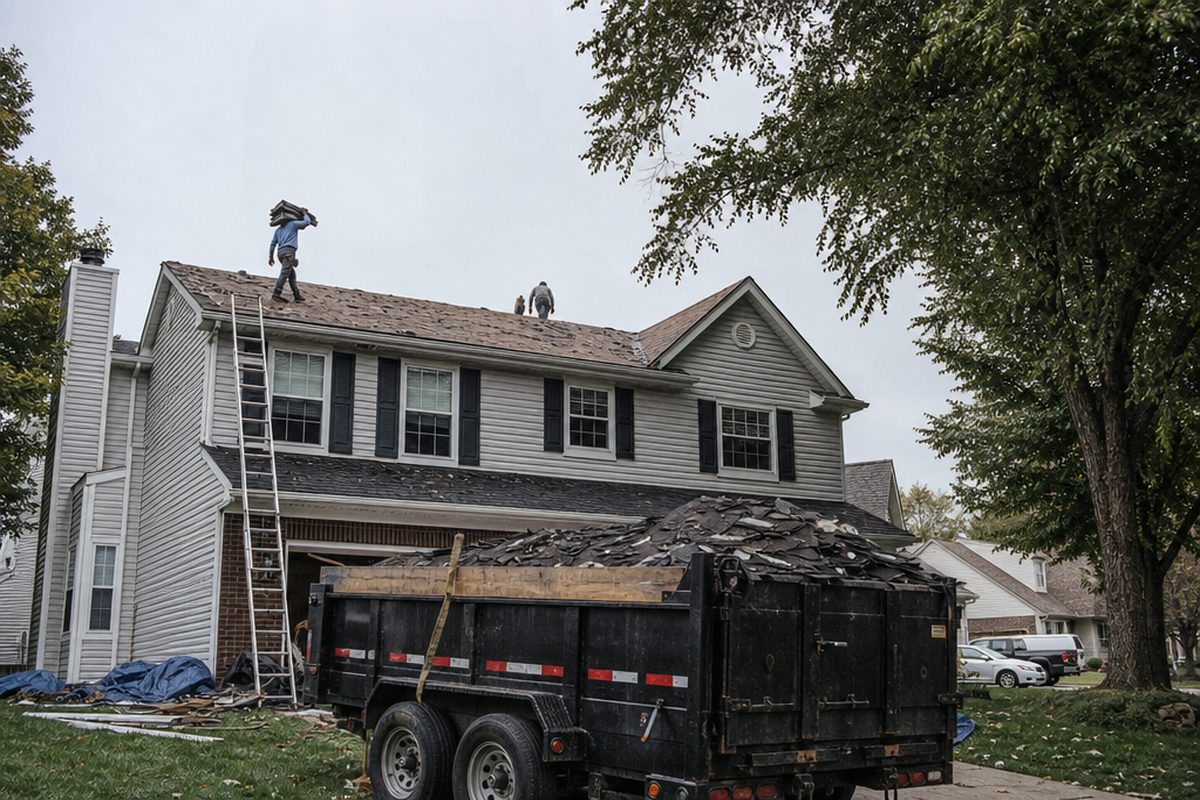
Roofing is the most competitive local trade to market in this region, and it is not close. The reason is structural: the job is expensive, the customer buys once or twice in a lifetime, and demand arrives in bursts after weather. That combination attracts a lot of money chasing the same homeowners, and it has built an entire industry that sells roofers leads instead of jobs.
Here is how the money actually works in southwest Ohio, and what to build if you want a pipeline you own.
Bought leads are a race to the bottom, by design
Roofing lead prices are high because the job value is high, and the platforms know exactly what a roof is worth. So you pay a serious per-lead price for a homeowner who is simultaneously being called by three or four other roofers who paid the same.
Once you are in that conversation, everything you have built is invisible. Your workmanship warranty, your crews, the fact that you actually return calls: none of it is on the table, because the homeowner is holding four numbers and no way to tell you apart. The lowest number wins a large share of the time, and the roofers who win consistently at that game are usually the ones who priced it in a way you should not want to match.
Three things make it worse in roofing specifically:
- You pay per lead, not per job, so a slow close month costs the same as a good one.
- Storm surges spike the price exactly when everyone else is bidding too. Your cost per lead is highest in the week you most need work.
- You build no asset. The homeowner belongs to the platform. When their neighbor needs a roof, the neighbor goes to the platform, not to you.
None of that means never buy a lead. Bought leads are a reasonable way to fill a gap in a slow week. They are a bad way to run a company, because five years of it leaves you exactly where you started with nothing to show for the spend.
Storm season and the year-round problem
Southwest Ohio gives roofers two different businesses in one year, and most marketing plans only account for one of them.
Storm demand arrives suddenly, concentrates in specific neighborhoods, and comes with insurance work attached. It also brings out-of-town crews who show up within days, knock the affected streets, and are gone by the time anyone needs a warranty honored. Competing on speed against a company with no local reputation to protect is a losing fight. Competing on being unmistakably local is not, and that is the argument to make loudly in those weeks.
Year-round demand is quieter and better: aging roofs, real estate transactions, leaks, and the homeowner who has been putting it off for two years. It is less dramatic, it is not seasonal, and it is where a well-built search presence pays for itself month after month.
The mistake is spending everything during storm season, when costs peak and competition is thickest, and going dark the rest of the year, when the same money buys far more. A budget that runs steady year-round, with a reserve you can deploy fast when weather hits, beats a budget that only exists in the six weeks after a hailstorm.
The owned-lead system
Three pieces. Each one works without the others, and they compound when they run together.
1. Google Business Profile, worked monthly
For "roofer near me," the map is the front door and the profile is what fills it. Reviews and photos are the two levers that move it, and both are free. A roofer who finishes eight jobs a month and asks all eight for a review will out-position a bigger competitor who does not, within a year. The whole routine is thirty minutes a month, and we broke it down in the monthly Business Profile routine for contractors.
2. A page for every roof type and every service
This is the piece most roofing sites get wrong. One "Services" page listing eight things cannot rank for eight things. Asphalt shingle replacement, metal roofing, flat and low-slope, storm and hail damage, roof repair, gutters, skylights: each of those is a different search by a different customer with a different budget, and each deserves its own page with its own photos and its own quote form on it.
The same logic applies to place. A real page about the towns you serve, with content that is actually about those towns, ranks. A page with the town name swapped into an identical template does not, and Google explicitly treats those as spam. That is the discipline behind our service area pages and the reason we build them slowly rather than generating fifty at once.
3. Ads on high-intent terms only
Paid search works well for roofing because the intent is unmistakable. Someone typing "roof leak repair Cincinnati" on a Tuesday night has water coming through a ceiling. That click is worth real money and should go to a page about roof leak repair, not your homepage.
The account discipline that matters most is the negative keyword list. Without it you pay for "roofing jobs hiring," "roof shingles home depot," "how to fix a roof leak yourself," and a long tail of searches that will never call anyone. We go through the account setup in detail in our guide to Google Ads for home services in Cincinnati.
What should a roofing lead cost?
Honest answer: it depends more on your close rate and average job value than on any benchmark, and any number you read online is a national average being applied to a market it does not describe.
The framework that actually helps is your own arithmetic. Take your average roof job value, multiply by the share of leads you close, and that is what a lead is worth to you. If your average job is $11,000 and you close one in five real leads, each qualified lead carries about $2,200 of revenue. Now a lead cost of $150 looks very different than it does in the abstract, and so does the decision to spend more.
Two cautions. Use qualified leads in that math, not every call, or you will flatter yourself into overspending. And use gross profit rather than revenue if you want the number to be genuinely decision-useful.
Planning the year
- Late winter and early spring. Build. Fix the site, get service pages up, get reviews moving before demand arrives. Cheapest time to do all of it.
- Storm season. Deploy the reserve fast. Lead with local, warranty, and licensing, because that is exactly what the out-of-town crews cannot say.
- Summer and fall. Steady spend on year-round replacement and repair searches. This is when owned search pays.
- Late fall and winter. Do not go dark. Reduce, keep the profile active, keep asking for reviews. Homeowners still research in December for spring work, and your competitors are quiet.
The short version
Buy leads to fill gaps, never as the plan. Work the Business Profile every month. Give every roof type and every service its own page. Run ads on high-intent searches pointed at matching pages. Measure cost per qualified lead against your own job value, not against a benchmark. And spend steadily year-round instead of only when it hails.
If you want an outside read on where your roofing leads are actually coming from and what each one costs you, that is a free conversation. Related: what a Cincinnati contractor should spend on marketing and our lead generation service.