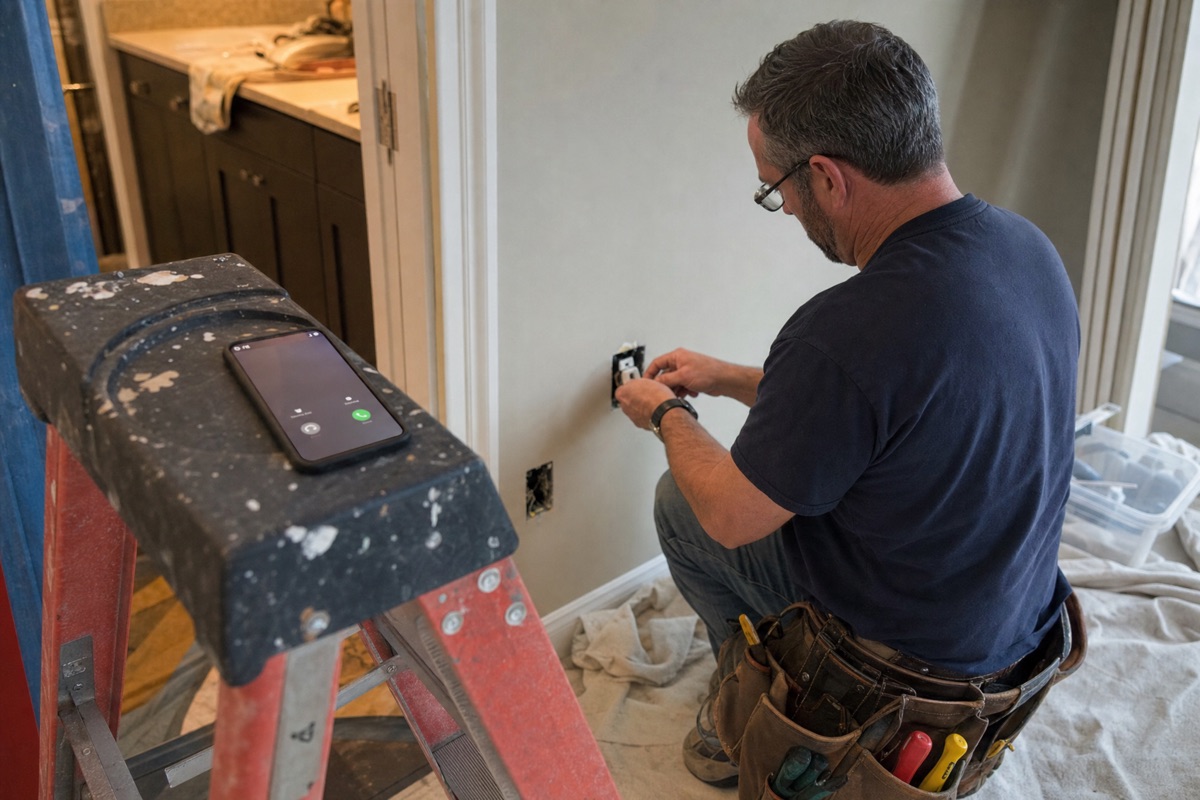
Ask a contractor how many calls he missed last week and you will usually get a shrug. Not because he does not care, but because a missed call leaves almost no evidence. There is a line in the phone log, and that is it. No angry email, no complaint, no lost invoice to look at. The customer just went somewhere else, quietly, and you never found out.
That is what makes this the most expensive problem on most contractors' books and the last one they get around to. So let us make it visible. The arithmetic below takes about four minutes and uses numbers you already have.
Work out your own number
Ignore any figure somebody else quotes you here, including ours. The only version of this that will change your mind is the one built from your business. You need three things:
- Your average job value. Not your biggest job. The middle of the road one, the kind that makes up most of your week.
- Your close rate on inbound calls. Out of ten people who call you cold, how many end up hiring you? Most contractors who have never measured it guess high. Use a number you would defend.
- Missed calls in a month. Pull up your call log and count. Count the ones with no callback attached, and count the ones you called back the next day, because those mostly belong in the same pile.
Multiply the three together and you have the revenue that walked past you. Here is the shape of it, using a mid-sized remodeling job as the example:
- Average job: $6,000
- Close rate on inbound calls: 1 in 4
- Missed calls last month: 12
- 12 × 25% = 3 jobs, or about $18,000 of work
Those figures are placeholders to show the method, not a claim about your market. Swap in your own and the number moves, but the direction rarely does. Even a contractor with an $800 average ticket and a 1-in-5 close rate is losing real money at a dozen missed calls a month, and the higher your job value goes the worse it gets. For anyone doing kitchens, roofs, or full HVAC systems, a single missed call can be the most expensive four rings of the week.
One honest caveat before you get worked up about the total. Not every missed call is a lost job. Some are suppliers, some are spam, some are people who call you back. Take a percentage off if you like. The point of the exercise is not a precise figure, it is finding out whether the number is closer to $500 a month or $15,000 a month, because those two answers deserve very different responses.
Why good contractors miss the most calls
There is a cruel logic to this one. The reason you cannot answer is that you are working, and the better you are, the more you are working. A contractor sitting in a truck with an empty schedule answers on the first ring. A contractor with a full week is on a roof, under a sink, in an attic, driving, or standing in front of a customer he does not want to interrupt.
So the phone rings out precisely when demand is highest, which is also exactly when you can most afford to be selective about the work. The season you most want to capture leads is the season you are least able to pick up.
Then it compounds. The homeowner who could not reach you calls the next company on the list. That company answers, books the estimate, and now owns the relationship, the job, and the review that comes after it. You did not lose to better marketing. You lost to availability.
Voicemail stopped being a safety net
Most contractors are still running on an assumption from fifteen years ago: if it matters, they will leave a message. That is no longer how people behave. A homeowner with a leak has three other numbers on the screen in front of them and no particular loyalty to any of them. Leaving a voicemail is slower than pressing back and calling the next one.
Which means a missed call is not a message sitting in a queue for you. It is a customer who is already talking to your competitor, usually within a minute or two. Treat your voicemail box as a record of what you lost, not a list of what to work through.
The same goes for form submissions that sit until the evening. Somebody who filled out a form at 10am and heard nothing by 2pm has, in their mind, already been told no. This is the same ten-minute research window we wrote about in why contractors lose jobs to companies that do worse work — the customer is comparing you to two other options in real time, and speed is one of the few variables you fully control.
Four ways to cover the phone
You do not have to answer every call personally. You have to make sure somebody or something answers, gets the details, and books the next step. There are four realistic options and they suit different sized businesses.
1. A person in the office
The best answer if you can carry the cost. A real person who knows the business can qualify properly, handle the odd question, and sound like the company. The catch is that it is a salary, it only covers business hours unless you are paying more, and one person cannot take two calls at once. For a contractor with steady volume and an existing admin, this is often already half solved.
2. An answering service
Cheaper than a hire and covers hours you do not. The trade-off is that the person picking up does not know your business, so what you usually get is a message taken slightly faster than voicemail. That is an improvement, not a solution, unless you invest real effort in the script and the qualifying questions. Ask any service you are considering exactly what they will say and what they will ask before you sign.
3. An AI voice agent
This is the option that has changed most recently. A voice agent answers on the first ring, every time, including at 9pm and on Saturday, asks the qualifying questions you decide on, and puts the appointment straight on your calendar. It never gets busy and never takes two calls badly because it can take twenty at once.
It is not right for everyone. If your work is highly diagnostic and the first call is genuinely a technical conversation, a bot will frustrate people. If your first call is mostly "what do you do, where are you, when can you come look at it, what is your name and number" — which for most trades it is — then it handles the whole thing. We go through what they cost and how they get set up in our guide to AI voice agents for small business, and it is the service side of what we build at Full Wave.
4. Callback discipline, which is free
If none of the above is happening this month, set a rule and hold it: every missed call gets a callback within one hour during working hours. Put it on whoever is closest to a phone. This costs nothing and it will recover a meaningful share of what you are losing, because plenty of homeowners have not made a decision an hour later.
It is the weakest of the four, and it is infinitely better than the current arrangement of calling back whenever you remember.
What "covered" actually has to mean
Whichever route you pick, it only counts if all four of these are true. Most half-measures fail on the third.
- Somebody answers within a few rings. Not eventually. Within the call.
- The name, number, address and the nature of the job get captured. A message that says "call John back" is worth very little.
- The next step gets booked on the call. An estimate on the calendar, or a firm time you will ring back. Ending a call with "someone will be in touch" puts the customer back into shopping mode.
- It reaches you somewhere you will see it. A lead that lands in an inbox nobody opens is still a lost lead.
That last point is where a lot of otherwise sensible setups leak. If your website form, your voice agent, and your answering service all deposit leads in three different places, you will lose some of them to sheer admin. Everything should land in one list you actually look at. That is the reason our client sites all post their leads into one dashboard rather than an email inbox.
Then measure it, or you will drift back
This problem returns quietly the moment nobody is watching, usually at the start of the busy season. Two numbers keep it honest, and both are easy to get:
- Answer rate. Of the calls that came in this month, how many were answered live? Your phone system or call tracking can tell you. Watch the trend, not the absolute figure.
- Time to first response. From the call or form submission, how long until a human being made contact? An hour is a reasonable bar during the day. Under fifteen minutes is a competitive advantage.
If you are running paid ads, this stops being optional. Ads generate calls at a cost per call, and missing them means paying for the click and throwing away the customer. Getting each booked job attributed back to the channel that produced it is its own piece of work, and it is the subject of how to tell which marketing is actually booking jobs.
Where to start this week
In order, and the first one takes four minutes:
- Count last month's missed calls and do the multiplication above. Whatever you decide next should be proportional to that number.
- Put a one-hour callback rule in place today. It costs nothing and it starts working immediately.
- Decide who or what covers the hours you cannot. Office, service, or voice agent, chosen against the number from step one rather than against what feels expensive in the abstract.
- Get every lead landing in one place. Calls, forms, and messages in a single list.
- Check the answer rate monthly. Ten minutes, once a month, so this does not quietly come back.
None of this is marketing, exactly. It is the plumbing underneath marketing. Spending money to make the phone ring while the phone goes unanswered is the single most common way we see contractors waste a budget, and it is also the cheapest thing on the list to fix.
If you want an outside read on it, we will call your business the way a customer would, at a couple of different times of day, and tell you honestly what happens. That is a free conversation and it usually takes about fifteen minutes.