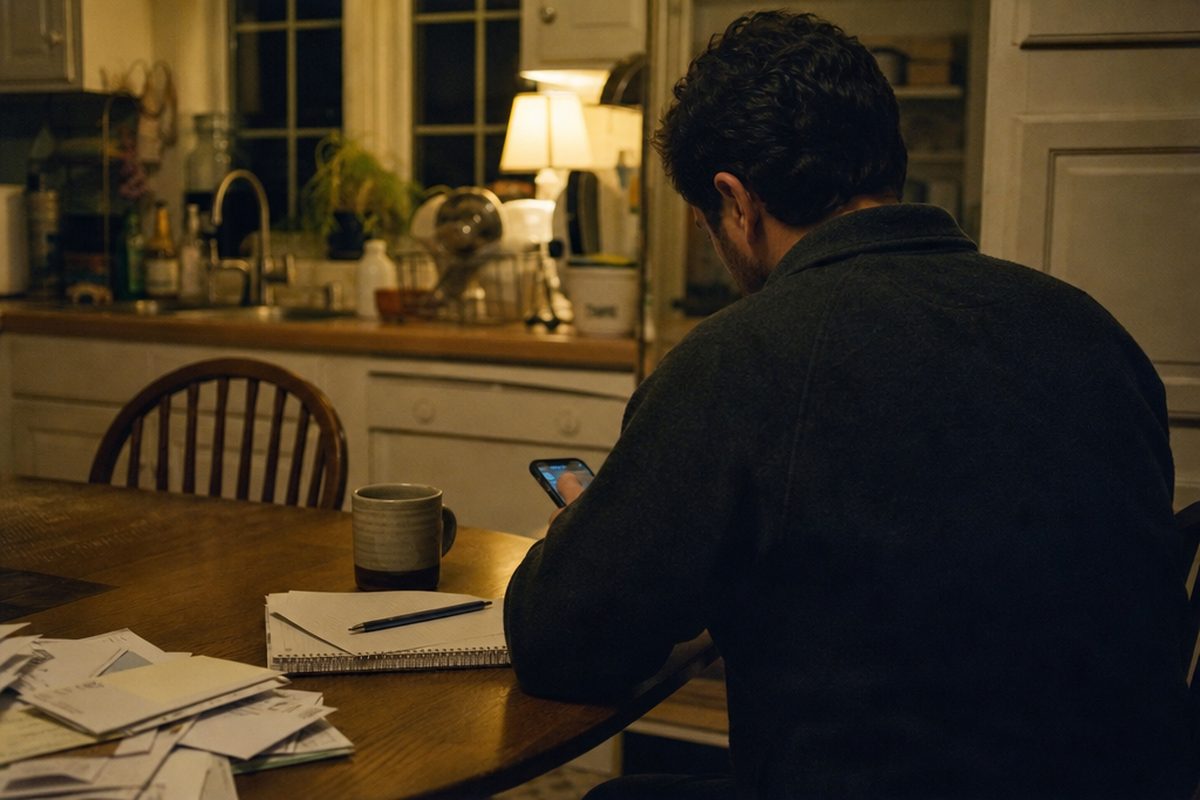
Every contractor has watched a job go to somebody whose work is worse than theirs. Usually there is a story attached: they lowballed it, they told the customer what they wanted to hear, the customer will regret it in two years.
Sometimes that is true. More often, the other company simply won the ten minutes where the decision actually got made, and you were never in the room for it.
The ten-minute window
Here is what really happens when a homeowner needs work done.
Something breaks, or they finally decide to do the project. They pull out a phone, usually at night, usually on the couch. They search. They look at the map results, tap two or three, glance at the star rating and the review count, look at a few photos, and maybe open a website for thirty seconds. They call or fill out forms for two or three companies. Then they put the phone down and wait for someone to call back.
The whole thing takes about ten minutes, and it happens before you know they exist. Every advantage you have, the twenty years, the craftsmanship, the fact that you actually show up, is invisible in those ten minutes unless it has been translated into something they can see on a phone screen.
That is the uncomfortable part. You are not losing on quality. You are losing a comparison you were not present for, judged on four things.
What they are actually comparing
Review count, then rating
Count comes first, and it is not close. A 4.6 with 180 reviews beats a 5.0 with 7 almost every time, because seven reviews reads as "friends and family" and 180 reads as "an actual company." Homeowners do not articulate this, but they act on it consistently.
This is where a lot of good contractors lose to worse ones, and the reason is almost always the same. The worse company asks for reviews systematically. The better company has been meaning to.
The fix is unglamorous and it works: ask every customer, the day the job wraps, with a link that takes one tap. Getting steady about that is the single highest-return marketing activity available to most contractors, and it is free. It is item two in our monthly Google Business Profile routine.
Photos of real work
They will scroll your photos before they read a word. What they are checking is whether your work looks like the thing they want.
Contractors consistently underestimate this and post four photos, three of which are the truck. Meanwhile the competitor has sixty photos of finished jobs. To a homeowner making a fast decision, sixty photos of finished work is evidence and four photos is a shrug.
Nothing here requires a photographer. Take a picture of every job when it is done. Before and after pairs work best because they show the problem you solve, not just the result.
Whether the website looks like a real company
Thirty seconds, on a phone, and they are answering one question: do these people look legitimate. Slow loading, text too small to read, a form that will not work with one thumb, a copyright date from four years ago. Each of those is a small deduction, and the deductions add up fast against a competitor whose page loaded instantly and said exactly what they do.
It is not about being beautiful. Plenty of ugly contractor sites book plenty of work. It is about being fast, clear, and obviously current. That is the bar our website work is built to clear before anything else.
How fast you call back
Which brings us to the one that decides more jobs than the other three put together.
Response time is the silent deal-killer
The homeowner contacted three companies. They are now waiting. Whoever calls back first gets to have the conversation while the other two are still driving to their next job.
That first conversation is worth an enormous amount. You get to ask questions, set expectations, frame what matters about the project, and be the standard the other two get compared against. The second caller is arguing with an impression that has already formed. The third caller often gets voicemail.
Two things make this brutal for good contractors specifically. The first is that being busy on jobs is exactly what stops you from answering the phone, so the better your work is, the worse your response time tends to be. The second is that people mostly do not leave voicemails anymore. A missed call is not a message waiting for you, it is a customer who is already talking to somebody else.
You do not have to answer every call yourself to fix this. You need somebody or something that picks up, gets the details, and books the next step. That can be an office person, an answering service, or an AI voice agent that qualifies the call and puts it on the calendar. What it cannot be is nothing, which is what most contractors currently have between 8am and 4pm.
We walk through what a missed call is actually costing you, using your own numbers, and what the options are for covering the phone — including an AI voice agent.
The fix list, in order
Do these in this sequence. Each one is cheap and the first three are free.
- Start asking every customer for a review. Today, with the last five jobs. Then make it part of closing out every job, permanently. This is the highest-leverage thing on the list.
- Photograph every job. Phone is fine. Upload them to your Google Business Profile monthly, and put the best ones on your website.
- Fix your callback time. Decide who or what answers when you cannot, and hold it to a target you would find acceptable as a customer. Under an hour during the day is a reasonable bar.
- Make your website load fast and read clearly on a phone. Not a redesign, necessarily. Speed, readable text, obvious phone number, a form that works with one thumb.
- Say specifically what you do and where. The services, the towns. Vagueness costs you the jobs you want and buys you the ones you do not, which is the subject of why your calls are not turning into good jobs.
None of this is about becoming a marketing company. It is about making the ten minutes reflect what you are actually like to hire, because right now, for a lot of good contractors, it does not.
If you want an outside read on what a homeowner sees when they look you up, that is a free conversation. We will search you the way a customer would and tell you what shows up.